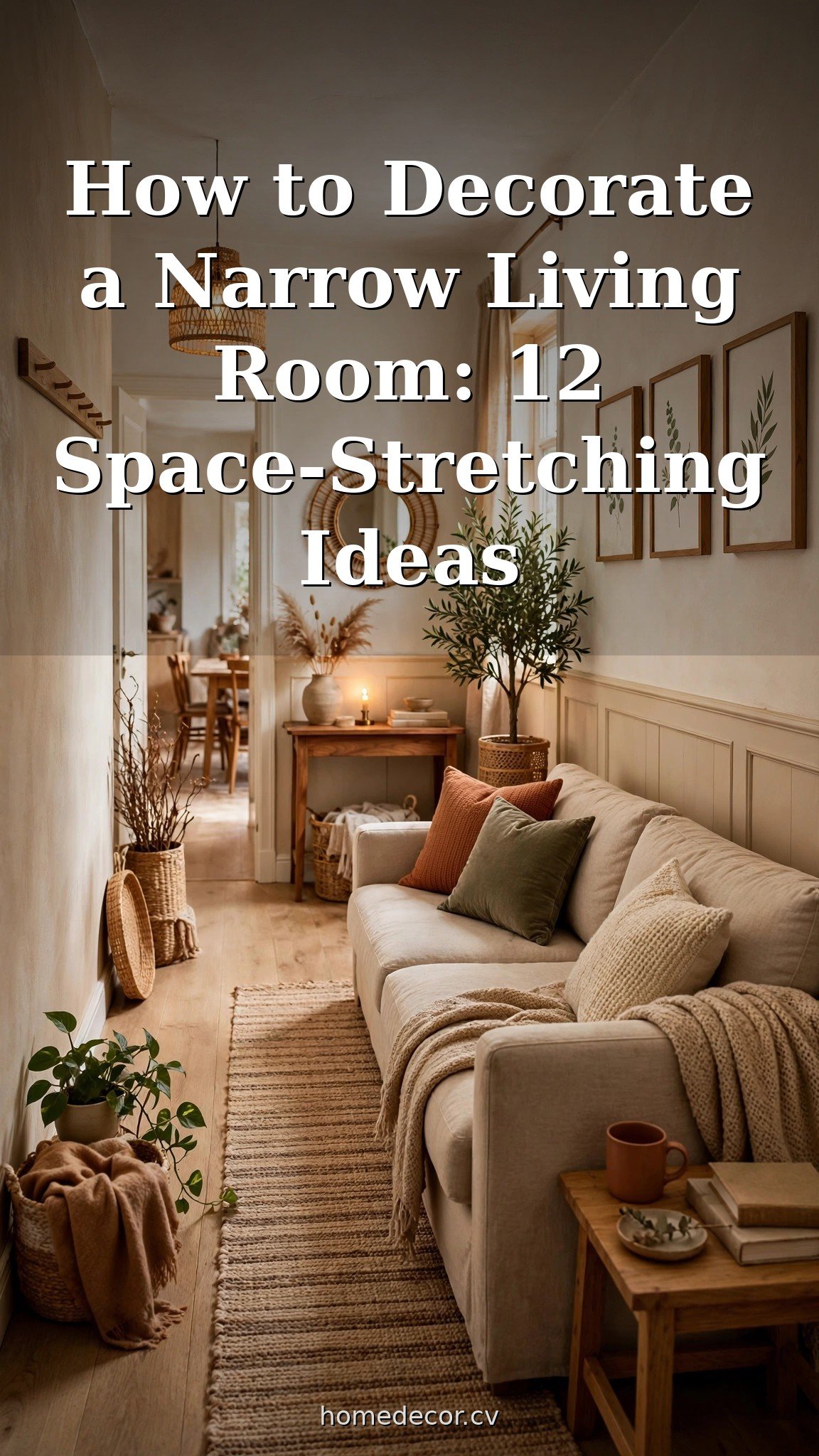
A narrow living room — long, tight, sometimes barely wider than a hallway — is one of the trickiest spaces to decorate. Push furniture against the walls and it feels like a corridor. Float everything and there’s nowhere to walk. If you’re wondering how to decorate a narrow living room without it feeling like a squeeze, the answer is a mix of smart layout, slim furniture, and visual tricks that stretch the space.
The good news: narrow rooms have a hidden advantage. They’re naturally cozy, they’re easy to light warmly, and with the right approach they feel intimate rather than cramped. These 12 ideas are renter-friendly, budget-conscious, and tested in real shoebox living rooms — no knocking down walls required.
For more small-space strategies, see our 21 Small Living Room Ideas That Feel Twice the Size and ideas for that 12 Empty Corner in Living Room Ideas That Actually Work.
How to Decorate a Narrow Living Room: Layout Strategies
Layout is everything in a narrow room. Get the arrangement right and the width stops mattering; get it wrong and no amount of decor will save it.
1. Put the sofa on the long wall and commit to one walkway
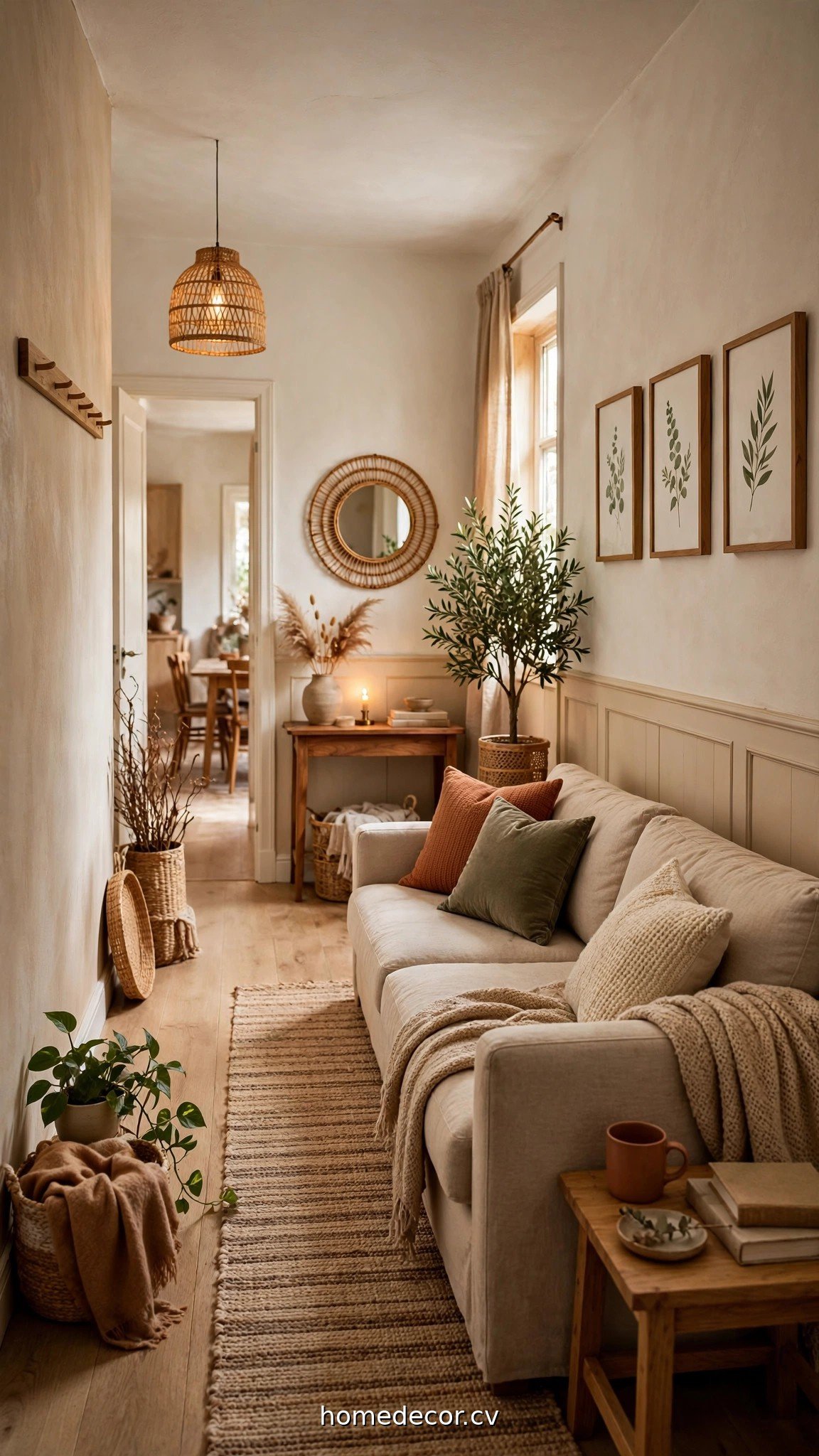
The single most important rule for how to decorate a narrow living room: place your sofa against one long wall and keep a single clear walkway along the opposite wall. Trying to split traffic on both sides guarantees a cramped corridor. One generous walkway (30 to 36 inches) feels intentional; two skimpy ones feel like an obstacle course.
Practical tip: Measure your walkway once the sofa is in place. If it’s under 30 inches, your sofa is too deep — look for apartment-scale sofas (32 to 36 inches deep) rather than standard 40-inch ones.
2. Float furniture slightly off the walls
Pushing everything hard against the walls actually emphasizes how narrow the room is. Pull the sofa even two inches off the wall, float a slim console behind it if space allows, and let a rug sit fully under the seating area. The tiny shadow gaps make walls feel farther apart than they are.
Practical tip: Renters, this also protects your walls — furniture pulled slightly forward doesn’t scuff paint, and you’ll thank yourself at move-out inspection time.
3. Divide the length into zones
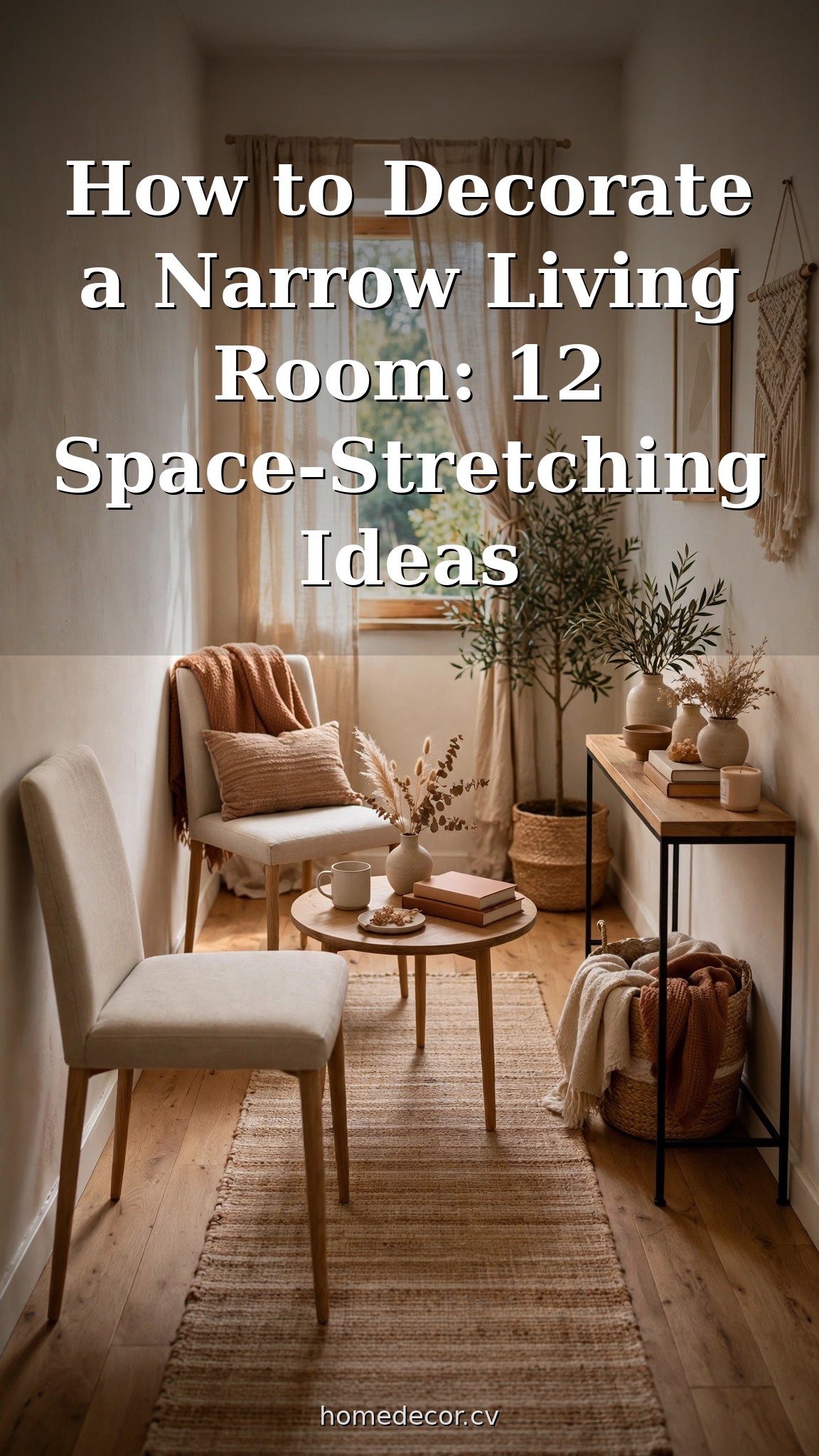
A long narrow room feels endless (in a bad way) when it’s one undefined stretch. Break it into two zones: a main seating area at one end and a secondary spot at the other — a reading chair, a small desk, a plant corner. A rug under each zone visually separates them, and suddenly you have “rooms” instead of a tunnel.
Practical tip: The zones don’t need walls or screens — a rug, a floor lamp, and a change of furniture orientation are enough to signal “this is a different area.” Keep the color palette consistent so the zones feel connected.
4. Angle one piece to break the box
Narrow rooms are all parallel lines, which the eye reads as “tight.” Angling a single armchair, or placing the coffee table on a slight diagonal, breaks the grid just enough to make the room feel wider. One angled piece is charming; five is chaos — restraint is key.
Practical tip: The classic move is angling a chair in the far corner at 45 degrees. It softens the room’s end wall, creates a cozy conversation angle, and costs nothing to try.
How to Decorate a Narrow Living Room: Furniture Choices
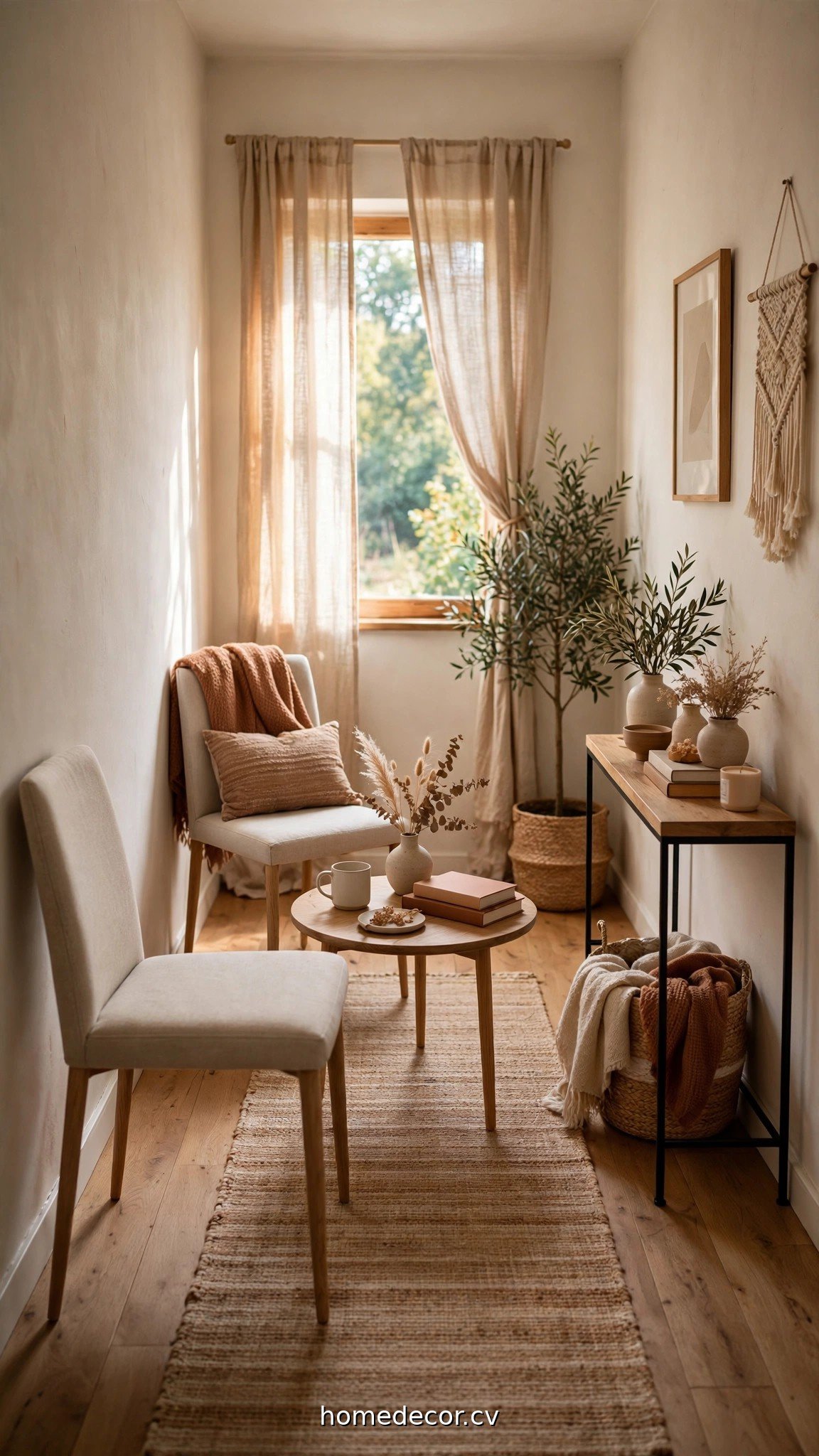
In a narrow room, every inch of furniture depth matters. Choosing slim, leggy, visually light pieces is the fastest way to buy back space.
5. Choose armless or slim-arm seating
Bulky rolled arms eat up to a foot of precious width. Armless chairs, slim-track-arm sofas, and settees give you the same seating in far less space — and because you see more floor and wall around them, the room reads as larger. A loveseat instead of a full sofa is often the right call in a truly narrow room.
Practical tip: Sit-test before you commit to armless. Some people miss arms for lounging — a compromise is a sofa with slim arms paired with one armless accent chair.
6. Go round with the coffee table
A round or oval coffee table is the narrow room’s best friend: no sharp corners jutting into the walkway, easier to navigate around, and the curved shape contrasts the room’s boxy lines so the space feels softer and wider. A 30 to 36-inch round table suits most narrow layouts.
Practical tip: Choose a table with a lower shelf or an open base. Closed, blocky coffee tables look heavy in narrow rooms; open or leggy ones let the eye (and light) pass through.
7. Pick leggy furniture that shows the floor
Sofas, chairs, and consoles on visible legs — mid-century style, essentially — reveal floor underneath, which tricks the eye into perceiving more square footage. A skirted sofa that hides the floor makes the same room feel smaller. When shopping, crouch down: if you can see under it, it’s narrow-room approved.
Practical tip: This is a great filter for secondhand shopping. Plenty of affordable vintage pieces have the leggy profile you want — and they’re often better made than new budget furniture.
8. Use vertical storage instead of wide pieces
Trade the wide, low bookcase for a tall narrow one. Swap the sprawling media console for a slim floating shelf. In a narrow room, storage should climb the walls, not sprawl across them — every horizontal inch is precious, while vertical space is usually going unused.
Practical tip: One tall bookcase (12 inches deep, 72 inches tall) holds as much as a wide low console at a third of the footprint. Anchor tall pieces to the wall — narrow rooms mean furniture gets bumped.
How to Decorate a Narrow Living Room: Visual Tricks
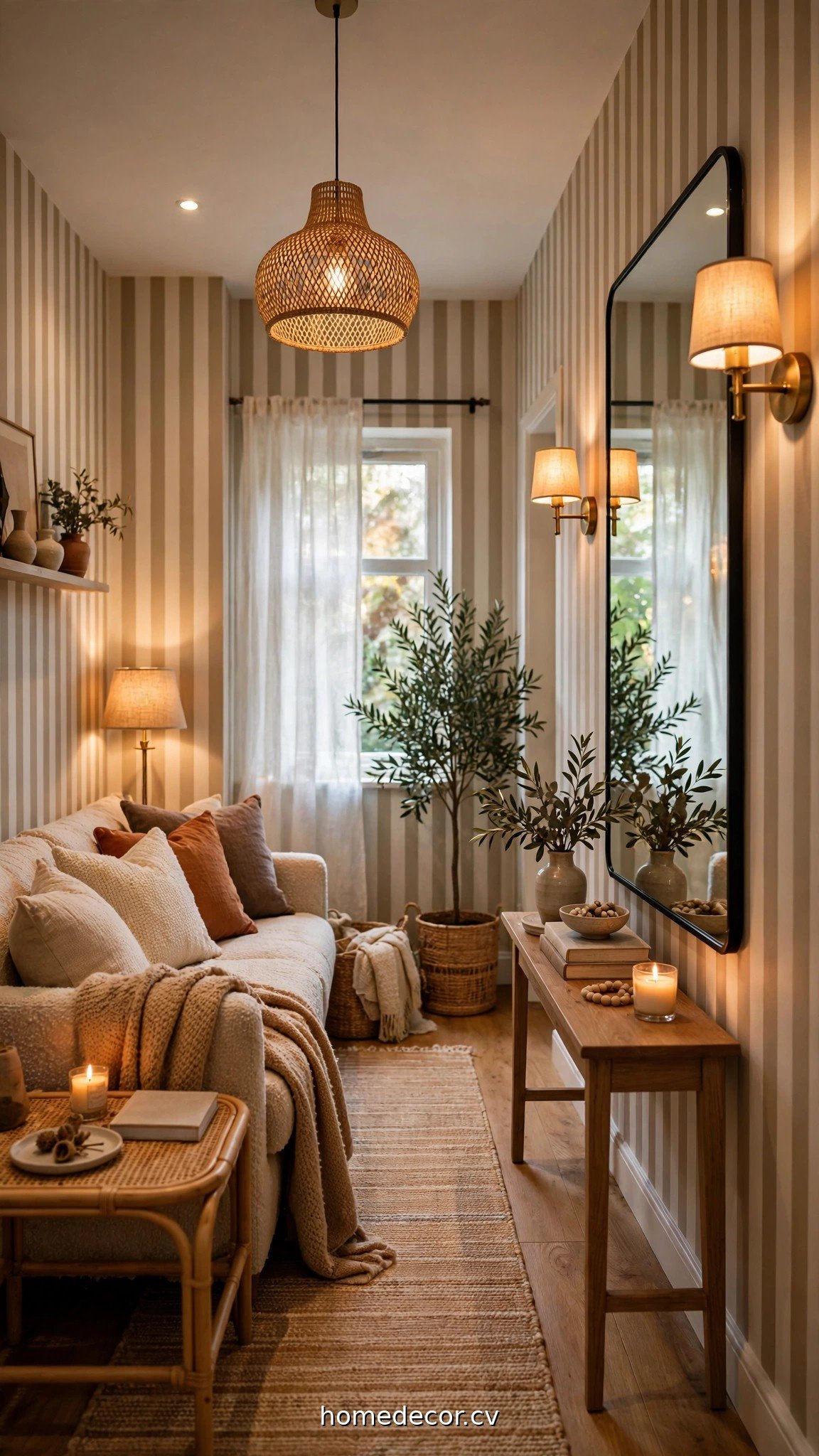
Once layout and furniture are sorted, these visual illusions stretch the room’s perceived width. They cost little and work immediately.
9. Hang a large mirror on the long wall
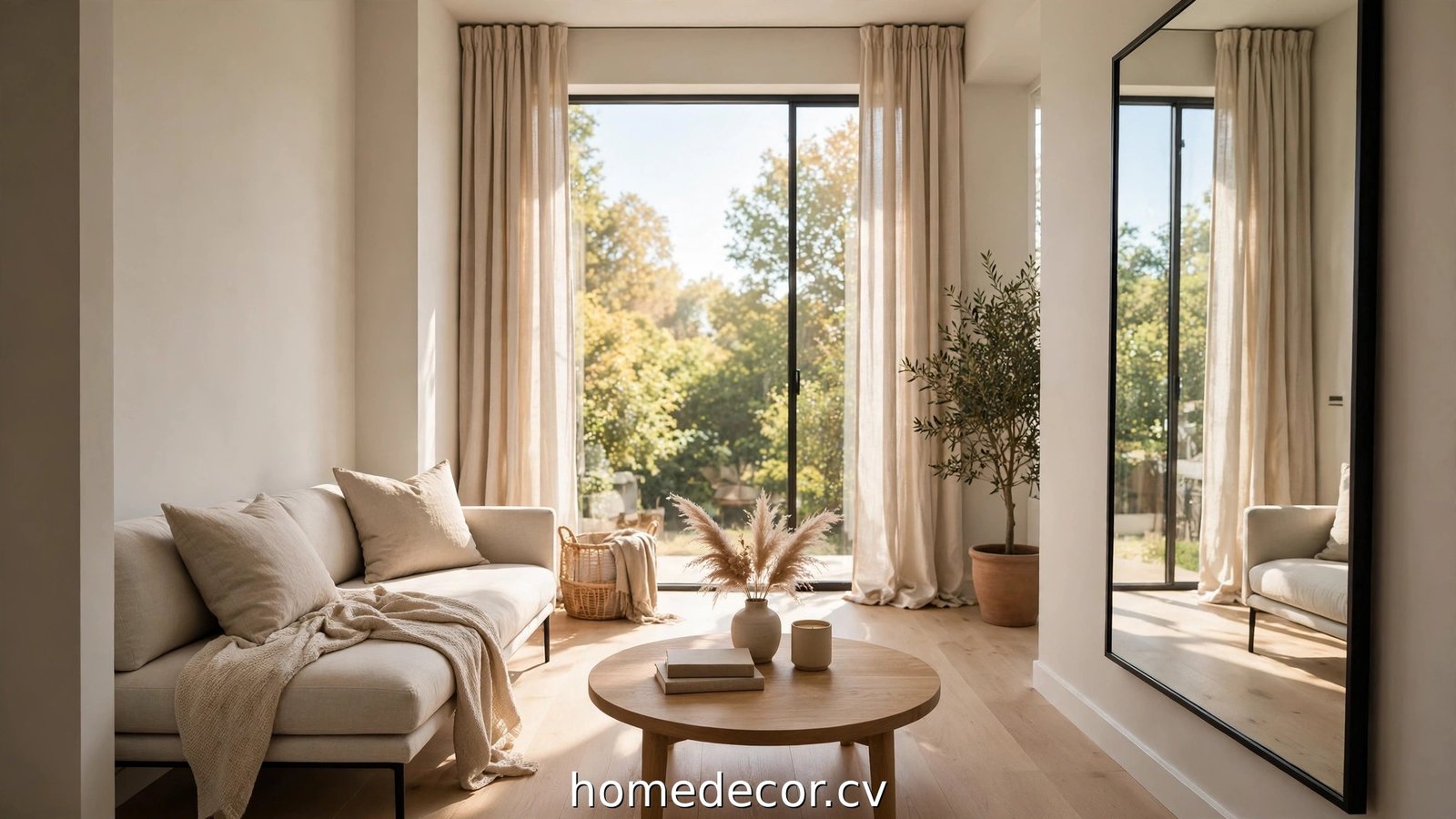
A big mirror on one long wall visually doubles the room’s width — it’s the oldest trick because it works. Go as large as you dare: a full-length leaning mirror or an oversized framed piece. Position it to reflect a window or a pretty vignette, not a blank wall or clutter.
Practical tip: Lean rather than hang if you’re renting — a large floor mirror leaned against the long wall needs no holes and can be wedged securely. Add rubber pads underneath so it can’t slide.
10. Run curtains wall-to-wall and floor-to-ceiling
Hang the curtain rod close to the ceiling and extend it well beyond the window frame on both sides — ideally nearly wall to wall on the window wall. Full, tall curtains draw the eye up and out, making both the window and the room feel far more generous. Light, airy fabrics enhance the effect.
Practical tip: This is the highest-impact cheap trick for narrow rooms. A $30 curtain rod mounted high and wide plus inexpensive curtain panels transforms the room’s proportions overnight.
11. Keep the palette light and continuous
Light walls, a light rug, and upholstery in similar tones blur the boundaries of the room so it reads as one airy volume. You don’t need all-white — warm creams, soft grays, pale sage all work. Add color in small doses (cushions, art, plants) rather than large blocks that chop the room into pieces.
Practical tip: If you can’t paint (renters), a large light-colored rug does 70% of the work of light walls. It covers the floor — the largest surface — in one brightening move.
12. Layer lighting at three heights
One overhead light in a narrow room creates harsh shadows that emphasize the tunnel feeling. Instead, layer: a floor lamp in one corner, table lamps at sofa height, and maybe LED strip or fairy lights on a shelf. Multiple warm light sources at different heights make the room feel enveloping rather than constricting.
Practical tip: Put the main lamps on dimmers or smart bulbs. Narrow rooms go from “cozy” to “cave” quickly in the evening — dimmable warm light lets you tune the mood precisely.
Keep Exploring
Love these ideas? Here are a few more you might enjoy:
- 21 Small Living Room Ideas That Feel Twice the Size
- 12 Empty Corner in Living Room Ideas That Actually Work
- 17 Gallery Wall Ideas for Beginners (With Layout Templates)
Frequently Asked Questions
Where should the TV go in a narrow living room?
Mount it on one of the short end walls if possible — viewing across the room’s length gives the best viewing distance in a narrow space. If it must go on a long wall, mount it flat (no protruding stand) and keep the seating opposite at a comfortable distance. A slim floating media shelf underneath keeps the floor clear.
How do I decorate a narrow living room on a budget?
Rearrange first (free), then spend on the two highest-impact items: curtains hung high and wide, and a large mirror — both available secondhand for very little. After that, it’s editing: remove one bulky piece and watch the room breathe. Most narrow rooms improve more from subtraction than addition.
Can a narrow living room still feel cozy, or will tricks make it feel cold?
The tricks that widen a room visually (light colors, mirrors, leggy furniture) pair perfectly with cozy layers (throws, warm lighting, soft rugs, plants). “Spacious” and “cozy” aren’t opposites — the goal is a room that feels open but still hugs you, which is exactly what layered warm lighting and textiles deliver.
What are the biggest mistakes in narrow living rooms?
Pushing all furniture flat against the walls (the corridor effect), using oversized deep furniture, splitting walkways on both sides of the seating, dark heavy colors on large surfaces, and one harsh overhead light. Fix the layout first — most narrow rooms are 80% layout problem, 20% decor problem.
Narrow Is a Feature, Not a Flaw
Learning how to decorate a narrow living room is really about working with the room’s nature instead of fighting it. One clear walkway, slim leggy furniture, zones along the length, mirrors and tall curtains for the illusion of width — and suddenly the “shoebox” becomes the coziest room in the house. Start with the layout this weekend; the rest follows naturally. For more small-space wisdom, browse our Living Room Ideas and Small Space Ideas categories.