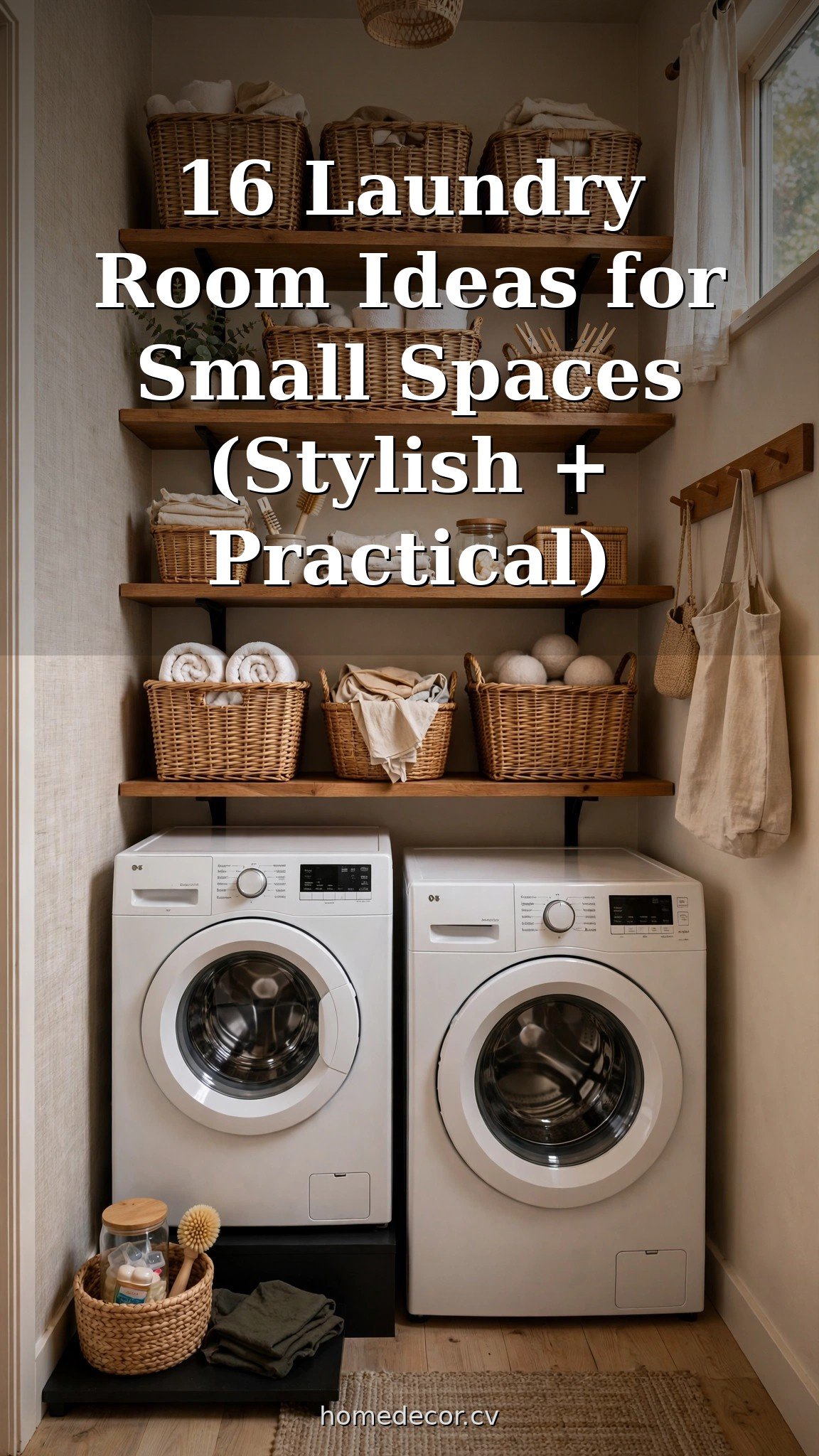
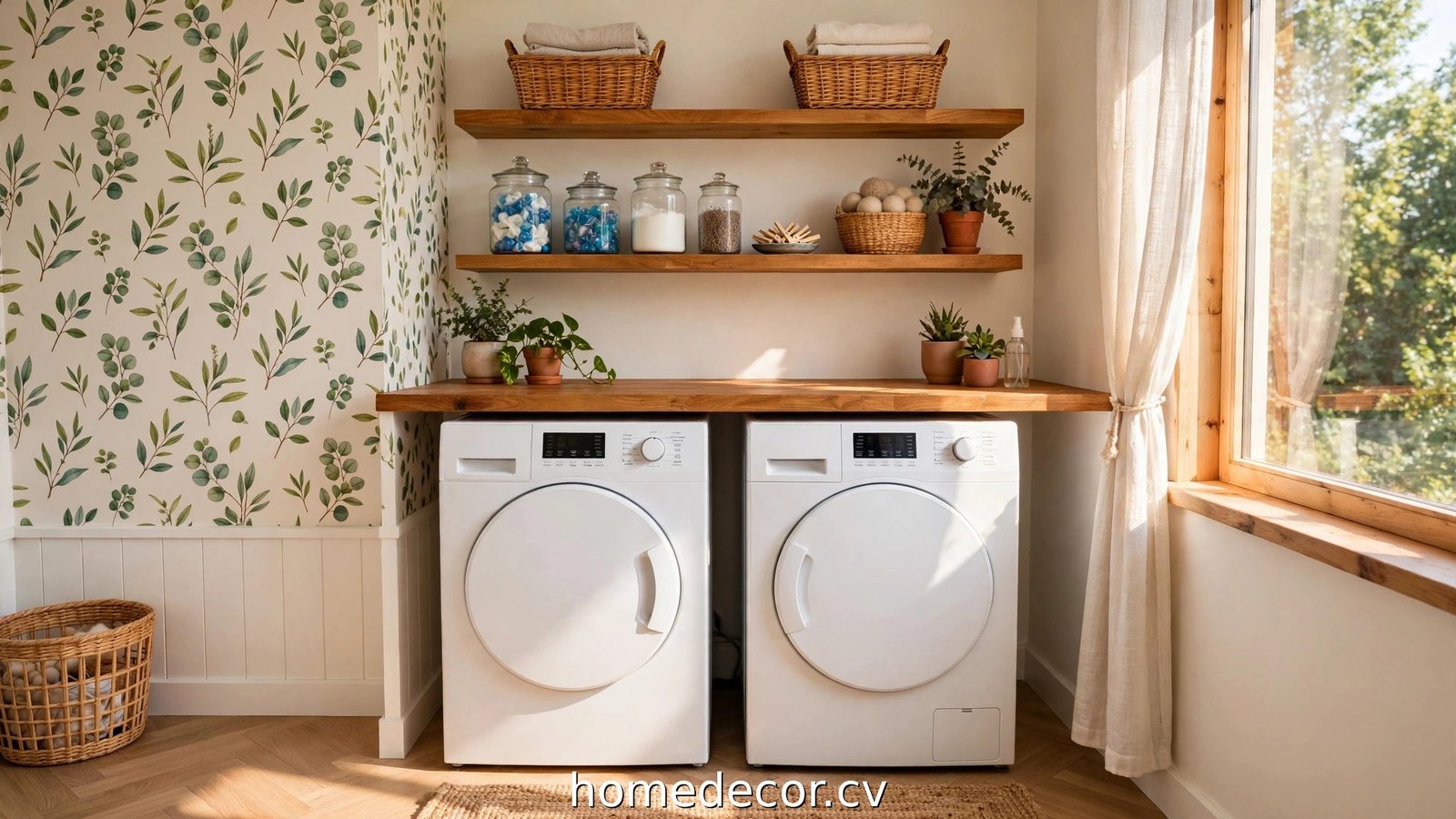
Nobody dreams of a beautiful laundry room — until they’re folding clothes in a dark, cluttered closet for the third time in a week. These laundry room ideas prove that even the smallest laundry corner can be practical, organized, and genuinely pleasant to spend time in. You don’t need a sprawling laundry suite; you need smart storage, good light, and a few pretty touches.
Small laundry spaces share the same challenges: nowhere to fold, nowhere to hang, supplies scattered, and zero joy. Below are 16 ideas in three groups — storage that squeezes into tight spaces, budget-friendly style upgrades, and layout tricks that make small footprints work harder.
Tackling other tight utility spaces? These 16 Small Laundry Room Ideas That Make Every Inch Work go even smaller, and 14 Mudroom Laundry Room Combo Ideas for a Hardworking Space handle the double-duty room.
Smart Storage in Tight Spaces
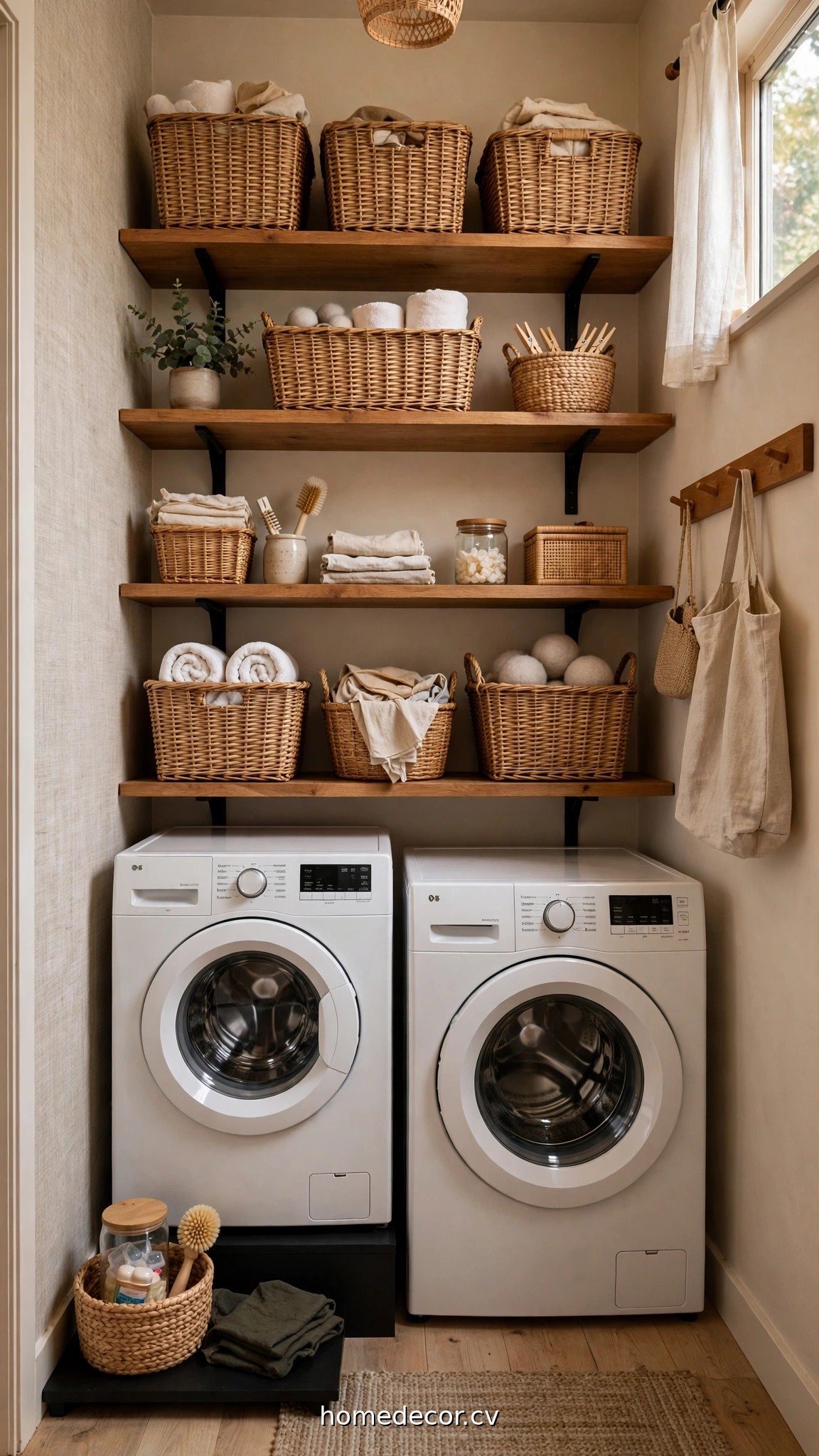
In a small laundry room, every inch must earn its keep — especially the walls.
1. Add a shelf above the machines
The wall above the washer and dryer is prime storage: one or two deep shelves hold detergent, stain remover, and baskets of supplies at eye level. It’s the single highest-impact upgrade for any laundry space.
Practical tip: Mount shelves at least 12 inches above the machines (more for top-loaders, which need lid clearance). Use brackets rated for the load — full detergent bottles are surprisingly heavy.
2. Slide a rolling cart between the machines
That 6-inch gap between the washer and dryer? It’s storage. A slim rolling cart with three or four tiers holds dryer sheets, stain sticks, and small supplies, rolling out when you need it and disappearing when you don’t.
Practical tip: Measure the gap before buying — “slim” carts range from 5 to 8 inches wide. Choose one with a handle and smooth-rolling casters; you’ll pull it out constantly.
3. Mount a wall-folding drying rack
A wall-mounted accordion or fold-down drying rack gives you generous hanging space that vanishes flat against the wall when not in use. It’s the small-space answer to the drying-rack-that-eats-the-room problem.
Practical tip: Mount it into studs — wet laundry is heavy, and a rack of damp jeans can easily exceed 30 pounds. Position it where drips won’t damage anything below.
4. Take cabinets to the ceiling
In small laundry rooms, the top two feet of wall are usually wasted. Run cabinets or shelves all the way to the ceiling for out-of-season and bulk storage — extra detergent, the vacuum, seasonal linens.
Practical tip: Keep a folding step stool in the laundry room permanently. If reaching the top shelf requires a quest, you’ll never use it — or worse, you’ll climb the dryer.
5. Sort with labeled baskets on shelves
Open shelves work best with a system: one basket per category — whites, darks, delicates, cleaning rags. Labeled baskets turn shelves into a sorting station and keep the room looking tidy even mid-week.
Practical tip: Use baskets with handles for the ones you’ll carry to the bedroom, and label them on both the front and top so they’re identifiable when stacked.
6. Install a pegboard for tools and supplies
A pegboard on any free wall organizes the odd-shaped stuff — lint rollers, small brushes, clothespins, the iron — that never fits neatly on shelves. Hooks rearrange in seconds as your needs change.
Practical tip: Frame the pegboard with simple trim for a finished look, and paint it a fun color. A pegboard doesn’t have to look like a garage — painted sage green or navy, it looks intentional.
Make It Pretty on a Budget
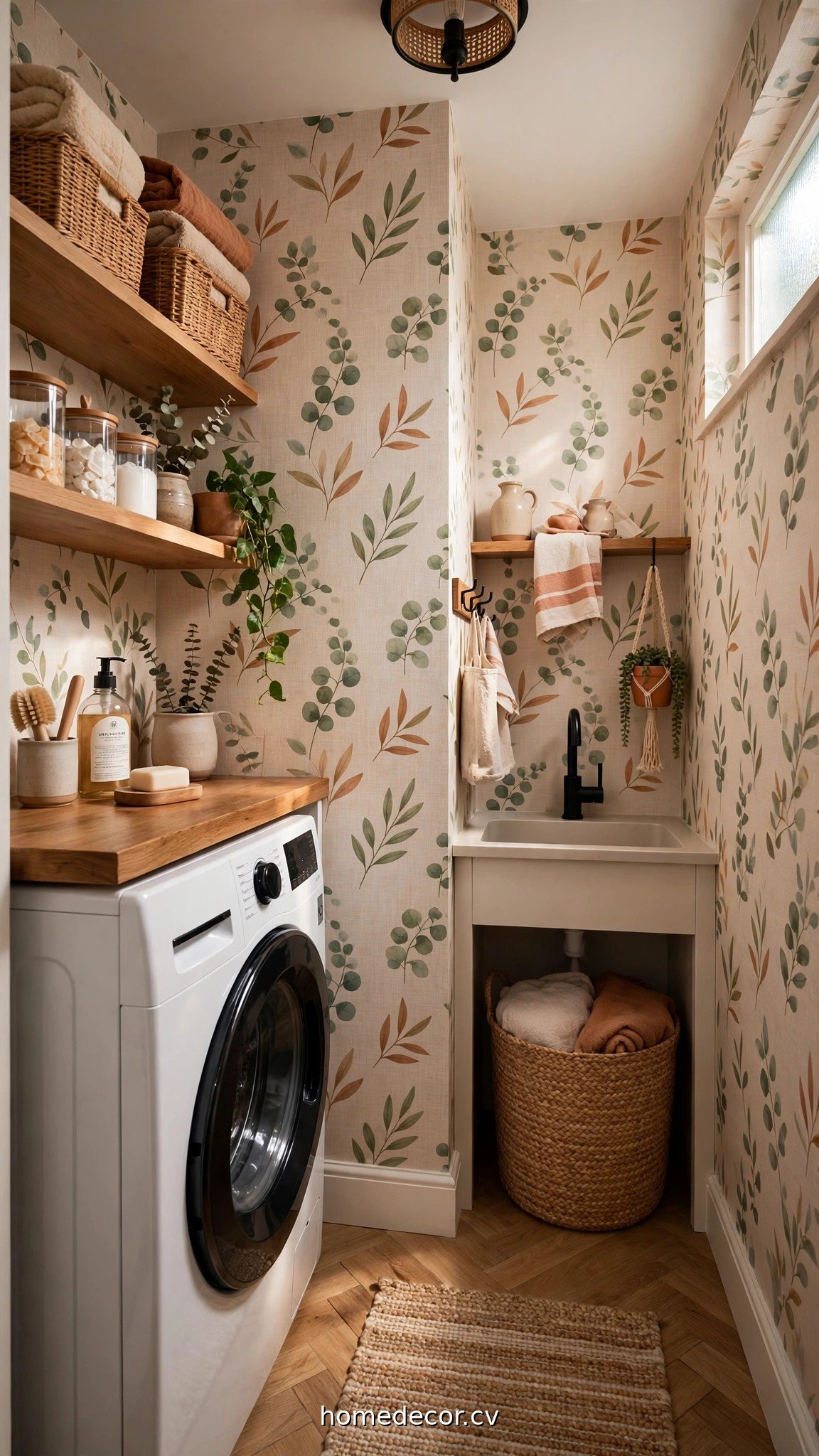
Pretty matters here more than anywhere — a nice-looking laundry room actually makes the chore feel lighter.
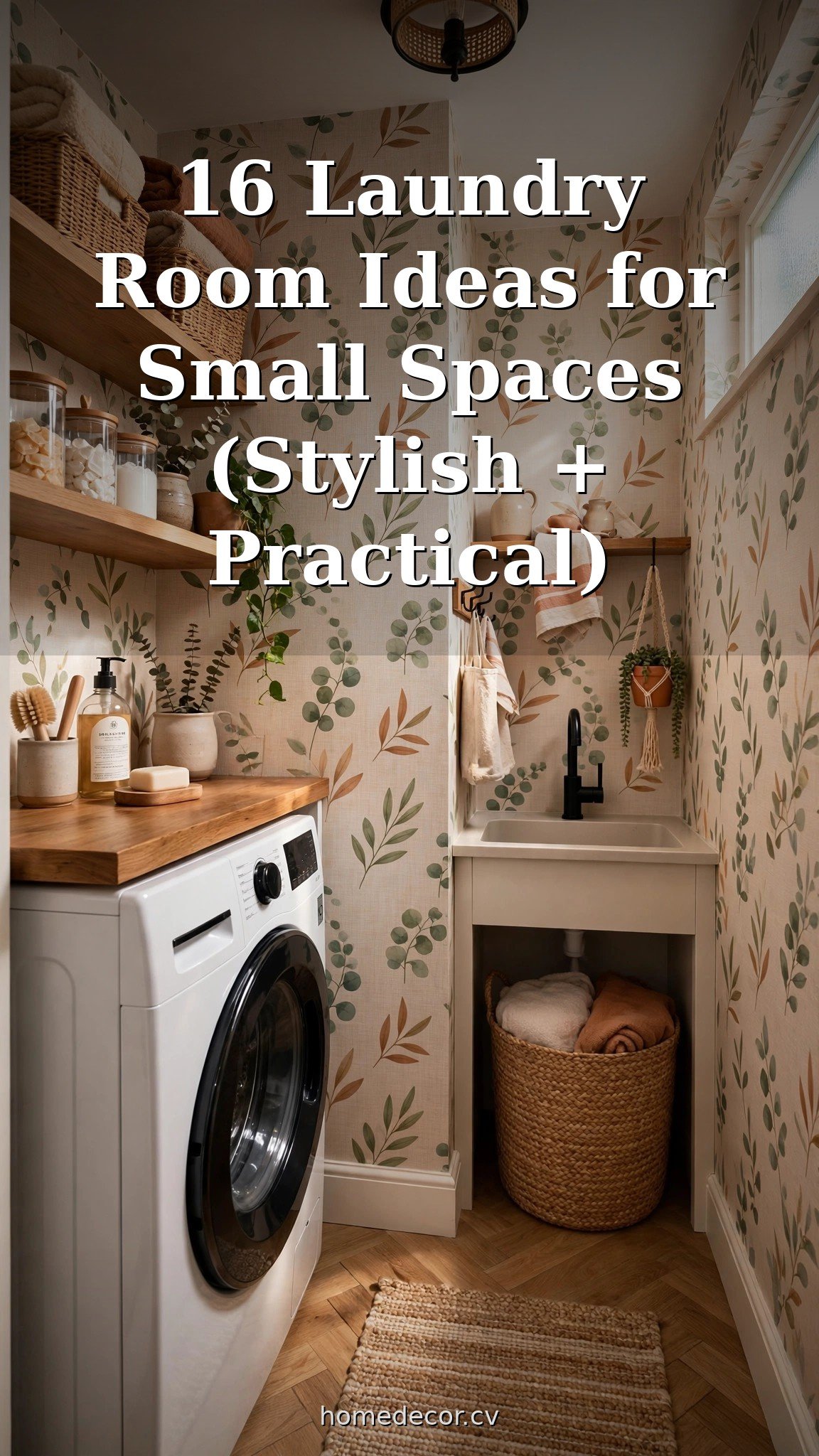
7. Apply peel-and-stick wallpaper to one wall
One accent wall of peel-and-stick wallpaper — botanical prints, subtle stripes, playful patterns — transforms a bland laundry room in an afternoon. It’s renter-friendly, affordable, and the small wall area means even bold patterns stay tasteful.
Practical tip: The wall behind open shelves is ideal — the pattern peeks between the shelves for maximum charm with minimum commitment. Smooth the wallpaper carefully around outlets and fixtures.
8. Paint the cabinets or machines’ surround
A coat of paint on builder-grade cabinets (sage green, navy, warm white) makes the whole room feel custom. Even painting just the wall behind the machines in a rich color adds depth to a tiny space.
Practical tip: Use cabinet-specific paint or add a bonding primer — laundry rooms are humid, and regular wall paint chips on cabinetry. Remove hardware and doors for the smoothest finish.
9. Decant detergents into matching dispensers
Those giant orange detergent jugs are functional but ugly. Decant detergent, softener, and scent beads into matching glass jars or ceramic canisters with simple labels. The shelf instantly looks like a boutique apothecary.
Practical tip: Keep the original bottles stored underneath with their measurement caps and safety instructions — decanting is for looks, but the originals hold the info you need. Never decant pods (a serious child-safety risk); keep those in their original child-resistant container.
10. Lay a washable runner rug
A low-pile washable runner in front of the machines softens hard tile, warms up the room, and catches the inevitable drips. In a narrow galley laundry, a runner also makes the space feel like a designed hallway rather than a closet.
Practical tip: Choose a dark pattern that hides lint and stray socks — light solid rugs in laundry rooms show everything. Machine-washable is non-negotiable here.
11. Upgrade the lighting
Most laundry rooms suffer under a single harsh bulb. Add a plug-in wall sconce, a battery-operated LED strip under the shelves, or simply swap the bulb for a high-CRI daylight LED. Good light makes stain-treating actually possible and the room infinitely more pleasant.
Practical tip: Aim for 4000K “neutral white” light in laundry rooms — it renders colors accurately so you can actually see stains, unlike warm bulbs that hide them.
Small-Space Layout Tricks
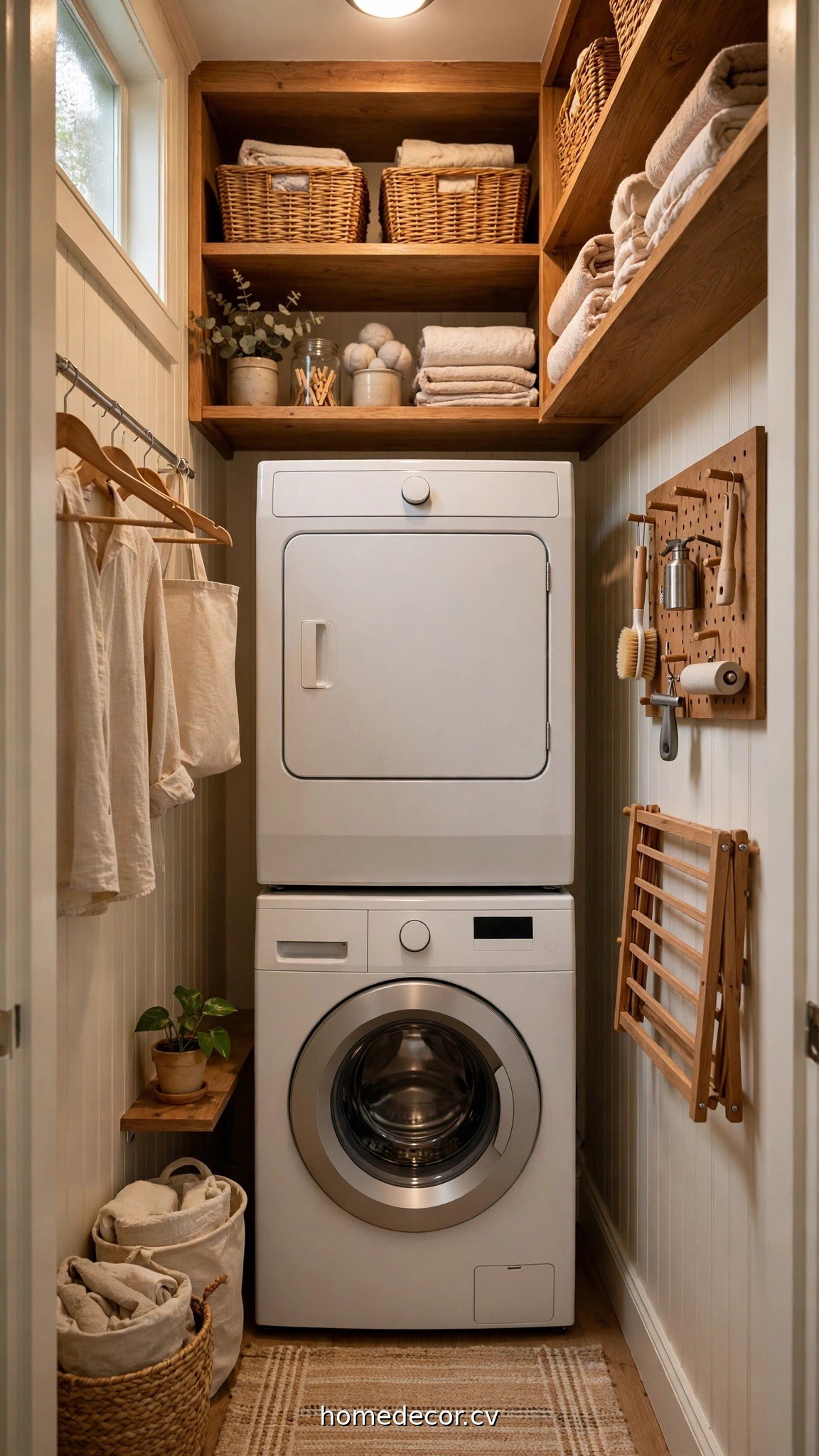
When the footprint is fixed, clever layout is everything.
12. Stack the units to reclaim floor space
Stacking a front-loader washer and dryer (with a manufacturer-approved stacking kit) frees up half the floor — room for a folding counter, a hamper station, or simply breathing space. It’s the biggest single gain in a tiny laundry room.
Practical tip: Only stack units designed for it, and always use the proper stacking kit — never balance a dryer on a washer unsecured. Front-loaders only; top-loaders can’t stack.
13. Add a countertop over front-loaders
A simple butcher-block or laminate counter spanning two front-loading machines creates an instant folding station — the flat surface small laundries always lack. It also hides the gap between machines for a built-in look.
Practical tip: Leave a 1-inch gap at the back for hoses and ventilation, and make the counter removable (resting on cleats, not screwed down) so technicians can access the machines.
14. Install a fold-down table for tight closets
In a laundry closet with no room for a permanent counter, a wall-mounted fold-down table gives you a folding surface on demand and disappears when the doors close. Pair it with the wall drying rack for a complete fold-and-hang station.
Practical tip: Mount the table at a comfortable folding height (36 inches) and choose brackets rated for at least 50 pounds — a heap of wet towels is heavier than it looks.
15. Hide it all behind a curtain
In open-plan homes where the laundry lives in a hallway or kitchen corner, a ceiling-mounted curtain on a track hides the machines completely when not in use. Choose a fabric that complements the room — linen-look curtains disappear elegantly.
Practical tip: Leave the curtain open while machines run — washers and dryers need ventilation, and trapped heat and humidity shorten their lifespan. The curtain is for the 95% of the time laundry isn’t running.
16. Use the back of the door
The inside of the laundry room (or closet) door is free storage: an over-door organizer holds stain removers and small supplies, hooks hold the ironing board, and a mounted lint-bin keeps dryer lint off the floor. It’s the most overlooked square footage in the house.
Practical tip: Choose slim over-door organizers that clear the machines when the door closes — measure the swing arc before buying. Soft fabric organizers are quieter than wire ones in tight spaces.
Keep Exploring
Love these ideas? Here are a few more you might enjoy:
- 16 Small Laundry Room Ideas That Make Every Inch Work
- 14 Mudroom Laundry Room Combo Ideas for a Hardworking Space
- 13 Small Narrow Laundry Room Ideas That Make Every Inch Work
Frequently Asked Questions
How do I organize a very small laundry room?
Go vertical: shelves above the machines, cabinets to the ceiling, a wall-mounted drying rack, and door-back organizers. Use the rolling-cart trick for gaps between machines, and contain everything in labeled baskets so open storage stays tidy. Every wall surface should be working.
What is the best layout for a small laundry room?
Side-by-side front-loaders with a countertop over them is the most functional small layout — you get a folding surface plus under-counter storage. If floor space is truly minimal, stack the units and use the freed half for a fold-down table and hamper station.
How can I make my laundry room look nice on a budget?
Peel-and-stick wallpaper on one wall, a fresh coat of paint on cabinets, decanted supplies in matching jars, and a washable runner deliver the biggest visual change for the least money. Good lighting (a daylight LED bulb) costs almost nothing and transforms how the room feels.
How do I add a folding surface to a laundry closet?
Three options depending on space: a countertop resting over side-by-side front-loaders, a wall-mounted fold-down table, or a rolling kitchen cart parked in front of the machines and wheeled away when done. Even a sturdy TV tray works in a pinch — any flat surface beats the top of the dryer.
Laundry Day, Upgraded
Nobody loves doing laundry — but a small, smart, pretty laundry room takes the dread out of it. Start with the highest-impact move for your space: shelves above the machines, a folding surface, or one wall of peel-and-stick wallpaper. By next laundry day, the chore will feel a little less like a chore — and that’s a win worth having.